
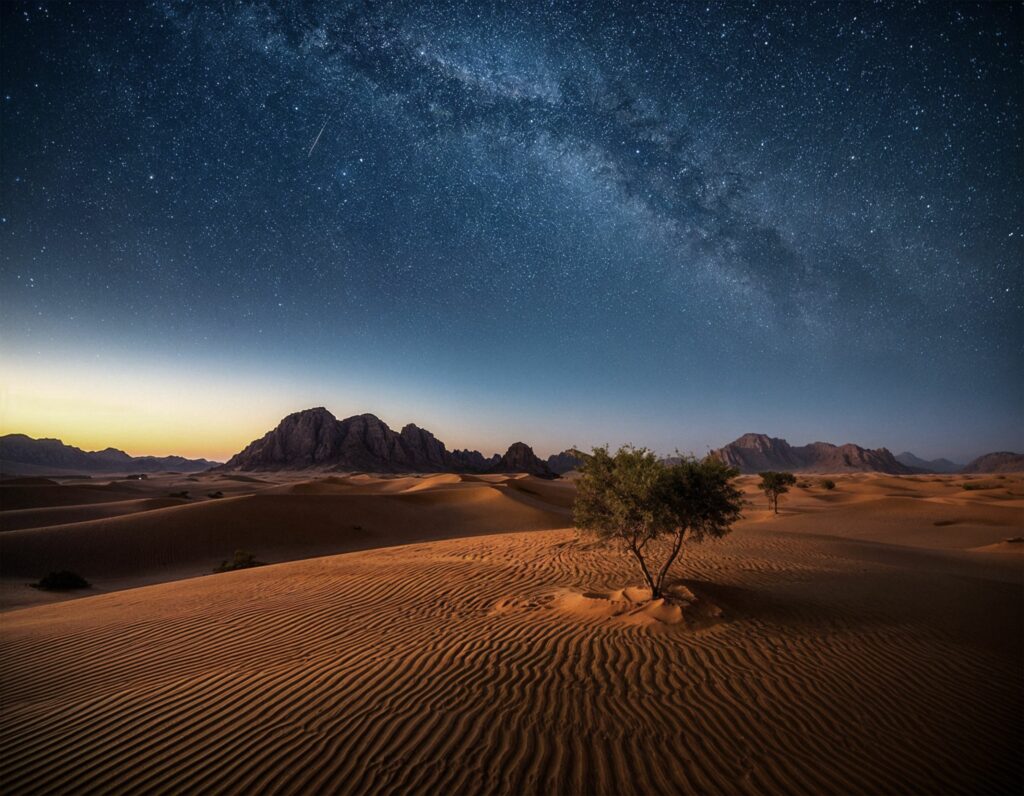
In February 2026, the ultimate luxury isn’t a gold-plated suite; it’s a view of the Milky Way. As urban light pollution reaches record highs globally, the tourism industry has pivoted to “Dark Sky” experiences. The Middle East, with its vast, unpolluted deserts and high-altitude plateaus, has emerged as the global leader in this niche, transforming AlUla (Saudi Arabia) and Jebel Akhdar (Oman) into the world’s premier “celestial theaters.”
1. AlUla: The Middle East’s First International Dark Sky Park
AlUla has officially transitioned from a “cultural secret” to a global stargazing icon.
- The Certification: In late 2024, AlUla became the first location in the Middle East to receive International Dark Sky Park certification. By early 2026, sites like Gharameel and AlUla Manara were ranked among the top 5% of the world’s darkest skies.
- Luxury Stargazing Lodges: High-end resorts like Banyan Tree AlUla and Habitas now offer “Stargazing Suites” featuring retractable roofs and private high-powered telescopes.
- The AlUla Manara Center: This newly opened space discovery center acts as the hub for Astro-tourism, offering Mars rover simulations and guided deep-space viewings.
2. Oman: The “Astro-Research” and Glamping Hub
Oman is leveraging its unique geography to combine scientific research with high-end “Astro-Glamping.”
- Jebel Akhdar & Jabal Shams: Known for their high altitudes and clear atmospheric conditions, these mountain ranges are seeing a surge in “cool-climate” Astro-tourism. In 2025, Jabal Shams recorded the first-ever sighting of the aurora in the Middle East.
- The Malkai Collection: Opening in 2026, this ultra-luxury tented concept includes a dedicated camp in the Al Hajar mountains, where “Murshids” (guides/philosophers) lead guests on spiritual and astronomical journeys.
- Omani Astronomical Society Study (Jan 2026): A landmark study released this month confirms Oman’s potential to establish Radio Quiet Zones (RQZs), positioning the country as a global scientific hub for terrestrial telescopes.
3. The “Dark Sky” Economy: 2026 Market Dynamics
- The “Lux-scaping” Trend: A new booking behavior where 80% of GCC travelers now “landscape” their trips with short, high-impact bursts of luxury, often choosing a 2-night remote “Dark Sky” stay to reset their mental health.
- Astro-Events as Catalysts: The countdown is on for the Total Solar Eclipse of August 12, 2026. While primarily visible in Europe, the event has triggered a massive interest in “Sky Tourism” across the Middle East as a precursor.
- Sustainability & Preservation: Regions like the Red Sea Destination in Saudi Arabia are aiming to become the world’s largest Dark Sky Reserve by implementing strict “downward-facing” lighting mandates and capping visitor numbers to prevent environmental degradation.
4. Why “Dark Sky” is Winning in 2026
| Feature | Traditional Luxury | Astro-Tourism (Dark Sky) |
| Primary Draw | Architecture & Amenities | Celestial Clarity & Silence |
| Environment | Urban / Developed | Remote / Pristine Desert |
| Tech Integration | Smart Home / Fast Wi-Fi | Smart Telescopes / VR Star Maps |
| Traveler Goal | Relaxation / Socializing | Spiritual Reset / Scientific Curiosity |